Shop travel
Shop travel
Shop travel
Stays
Stays
Flights
Flights
Cars
Cars
Packages
Packages
Things to do
Things to do
Deals
Groups & meetings
Open app
PHP
List your property
Support
Trips
Communication Center icon
Sign in
Members save 10% or more on over 100,000 hotels worldwide when you’re signed in
Sign in
Learn about Expedia Rewards
Feedback
Asia
Pyatovskoe
Russia
Asia
Plan your trip
Hotels in Pyatovskoe
Vacation Rentals in Pyatovskoe
Car Rentals in Pyatovskoe
Pyatovskoe Vacation Packages
Pyatovskoe
Travel Guide
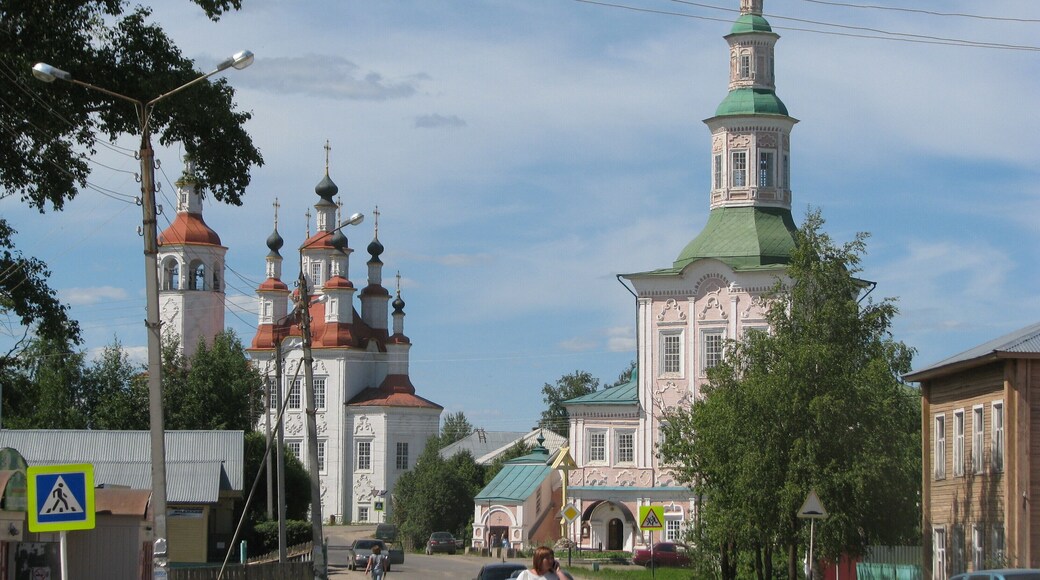
Totma’s founding date is considered to be the year 1137, on the basis of a letter from the Novgorod Prince Svyatoslav Olgovich. From the 15th century until the 18th century, Totma remained one of the largest salt cities and at one time was also called Posad Salt Totemskaya or Totemskaya Salt. The 17th century becomes the heyday for Totma, as well as for other cities on the North Dvina waterway. Virtually all foreign trade of the Russian state, due to the lack of access to the Baltic Sea, was carried out through Vologda, Totma, Veliky Ustyug and Arkhangelsk, which contributed to the appearance in Totm of courtyards and representative offices of foreign merchants and trade missions. In just one year, from 500 to 1000 ships passed through the city [6]. The trade value of the city, which was strengthened due to the further development of salt mines, allowed Totme to be one of the richest and most important cities of the Russian kingdom. In the second half of the 18th century, a total of expeditions to the east — to Siberia, to the Far East, and to the shores of the Americas — were carried out by the Totmichians — Kholodilovs, Panovs, Cherepanovs, and a number of others. Companies totem merchants outfitted about 20 expeditions into the Pacific. During these expeditions geographical discoveries were recorded, recorded by science in 1755, maps of a number of islands were made. These expeditions exported 1/5 of all fur produced in the Americas for half a century - a record figure among Russian cities [6]. Fur trade brought tangible profits; so, with the money raised in Siberia, the Totem merchants and sailors had the opportunity to build richly decorated and large enough temples for such a small town: Entrance to Jerusalem, Trinity, Rozhdestvensky. In 1785, Empress Catherine II adopted a decree on giving Totme a coat of arms with a black fox on a golden field: “as a sign of the fact that the inhabitants of this city catch these animals in fishing” [6]. Totmichi proved to be active participants of the Russian-American company, mastered the expanses of the Pacific Ocean, discovered a number of Aleutian and Commander Islands [6]. Totmich Ivan Kuskov on the coast of Northern California near Bodega Bay Bay in 1812, Fort Ross Fortress was founded, which became the most southerly point of Russian America.
2
See all 2 photos
Check-in
Check-out
Guests
Search
Explore map
Visit Pyatovskoe
Check Pyatovskoe hotel availability
Check prices in Pyatovskoe for tonight, Feb 17 - Feb 18
Tonight
Feb 17 - Feb 18
Check prices in Pyatovskoe for tomorrow night, Feb 18 - Feb 19
Tomorrow night
Feb 18 - Feb 19
Check prices in Pyatovskoe for this weekend, Feb 20 - Feb 22
This weekend
Feb 20 - Feb 22
Check prices in Pyatovskoe for next weekend, Feb 27 - Mar 1
Next weekend
Feb 27 - Mar 1
Go further with the Expedia app
Save on select hotels and earn double points when you book on the app. Our app deals help you to save on trips so you can travel more and manage it all on the go.
Scan the QR code with your device camera and download our app
6183ee62-47bc-4926-ba53-591f7d4213f9
40b3140b-be06-4be9-9752-c03ed54f6ea0