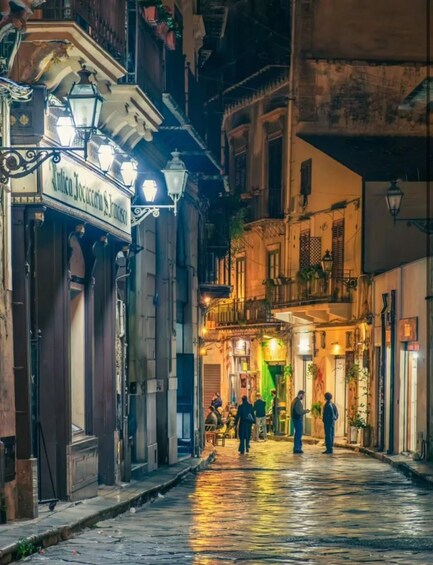
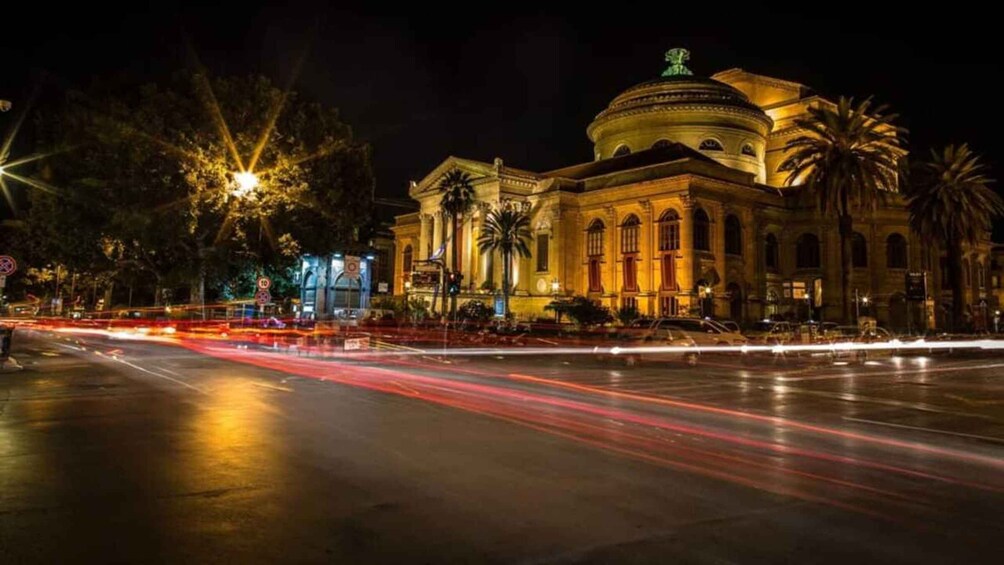
We start in front of Teatro Massimo, where the convents demolished to build the opera house left behind an abbess who still haunts the corridors: singers lose their voice, and nobody mocks the legend on the first step of the staircase. From there the walk crosses the Capo district: the courthouse and its Lady in White, seen by a carabiniere at three in the morning in 2011; the market where Giovanna Bonanno sold her “arcane liquor” to unhappy wives in the 1780s, until the deaths added up; the bell tower of the Mercede, where a nun appears every evening since 1746; and the alleys where the Beati Paoli, the secret brotherhood of Palermo, are said to have met underground.
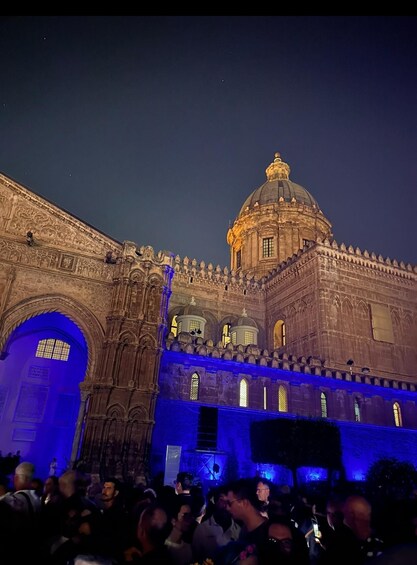
At the Cathedral we sit on the benches with a glass of Sicilian wine, in front of the chariot of Santa Rosalia, for the darker origin of the city's patron saint. Then the Vucciria and the Garraffello fountain, where a crocodile once ate the people who leaned in too far; Palazzo Steri, seat of the Spanish Inquisition, with the graffiti the prisoners scratched into the walls; the Kalsa and the wolf-woman who roamed the ruins after the 1943 bombing; and Piazza Sant'Anna, where the tour ends with the vampire of Palermo, a story about a decaying aristocracy that is not entirely a story.
This is a storytelling walk, not a food tour and not an art-history tour. You eat and drink outdoors, in the squares, as Palermitans do: one glass of wine and a slice of sfincione, Palermo's thick tomato-and-onion focaccia, from a pastry shop in the Capo. If you want dinner, the tour ends in a square full of bars and restaurants, and your storyteller will tell you where to go.