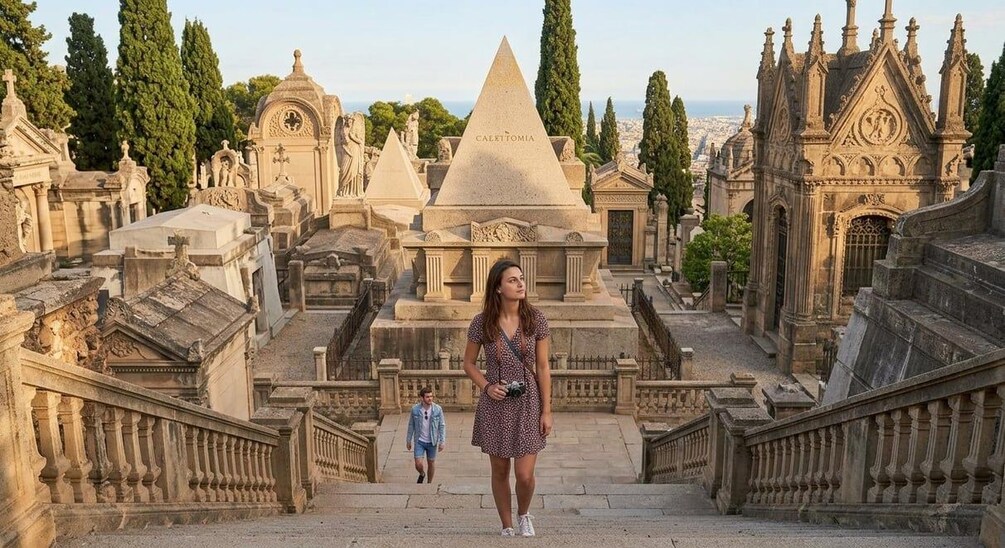
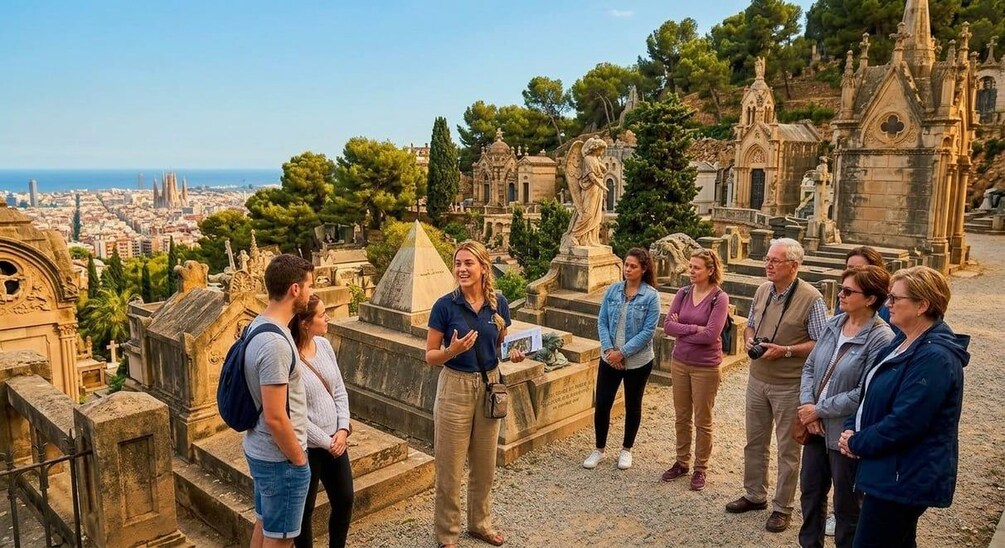
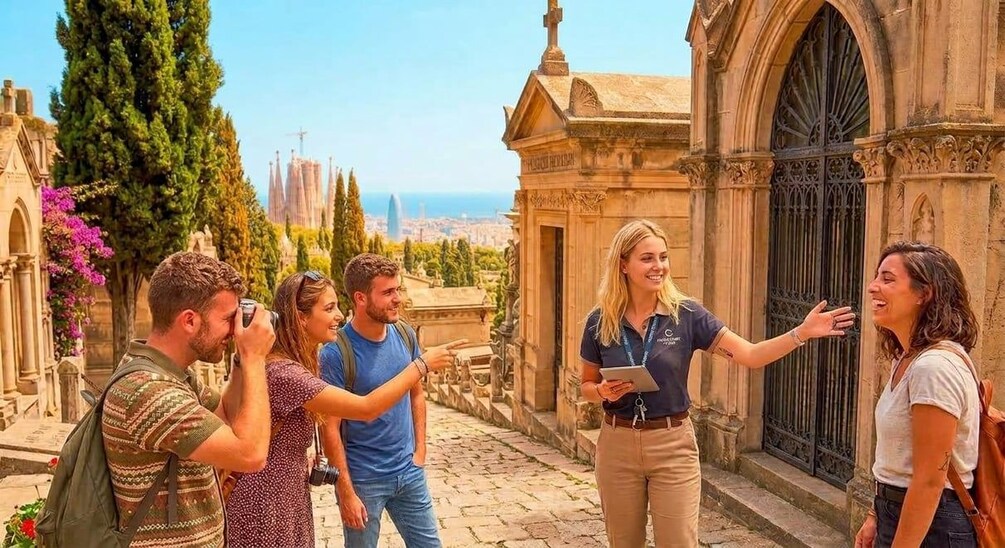
There's a place in Barcelona where you can walk for three hours and pass fewer than five other people: Montjuïc Cemetery, 56 hectares of Art Nouveau architecture, hidden history and Mediterranean views that almost no tourist ever reaches. This isn't a “spooky graveyard” tour built around skeletons for a cheap scare — it's a guided walk that helps you understand, through the tombs themselves, how modern Barcelona was actually built.
We start where Barcelona's 19th-century elite made their last competitive move: their own family tombs. The same families who built the Art Nouveau mansions on Passeig de Gràcia commissioned miniature palaces here, including a striking 12-metre Egyptian-style pyramid. You'll learn why Ancient Egypt became fashionable in 19th-century funerary art, and where the money for all that luxury came from — much of it from trade with Cuba and the colonies.
Climbing higher, we reach the people who shaped the Barcelona you already know without realizing it: Ildefons Cerdà, the engineer behind the Eixample grid, whose gravestone reproduces the very street plan you've probably walked; Joan Gamper, founder of FC Barcelona; and painter Joan Miró, among other notable Catalans.
The tour doesn't shy away from harder history: we visit the joint monument to anarchists Buenaventura Durruti and Francisco Ascaso and educator Francisco Ferrer i Guàrdia, then reach the Fossar de la Pedrera, a former stone quarry turned memorial for those executed under Franco's dictatorship — the most emotional stop, handled with the respect it deserves.
We close the loop with something few cemetery tours in Europe show: how the way Barcelona deals with death is changing today, from 19th-century pyramids to discreet modern tree niches, as cremation now accounts for over half of all deaths in the city.
What you'll get:
A local expert guide, not an audio guide or an app
Small groups for a personal, unhurried pace
A route covering Art Nouveau tombs, Egyptian Revival architecture, illustrious Catalans and Civil War memory
A closing viewpoint over the Mediterranean Sea
Perfect for history lovers, architecture and art enthusiasts, and anyone who wants to see a side of Barcelona that goes beyond Sagrada Família and Park Güell — with almost no crowds.